Sweden’s New Work Permit Rules Are Live — Complete Guide – Updated June 16, 2026
Last update: June 16, 2026
——–
The Sweden work permit rules 2026 are not just approved—they are now live. From June 1, 2026, we are navigating a completely new landscape for work permits in Sweden. But on June 16, a crucial update occurred that many missed: Statistics Sweden (SCB) raised the national median salary, which immediately redrew the map for the salary requirements needed to get a permit approved.
If you are an employer with applications in motion, or a candidate waiting for a decision, these new levels can impact the decisions landing on your desk this very week.
As your specialists, let’s walk through the 5 most important changes and how you and your company can best navigate them.
In this article
1. The new salary requirement is now SEK 34,470 (90% of median salary)
The absolute biggest change is that the previous requirement for good support (80% of the median salary) for first-time applications has now been replaced by a strict salary threshold. The main rule is that the monthly salary must amount to at least 90 percent of Sweden’s median salary.
With SCB’s update in June 2026, the median salary is SEK 38,300. This means the new floor to be granted a work permit is SEK 34,470 per month.
Important to keep in mind:
- The salary must still be in line with Swedish collective agreements or industry practice.
- If the collective agreement or practice for the profession requires a higher salary than SEK 34,470, you must match that higher level.
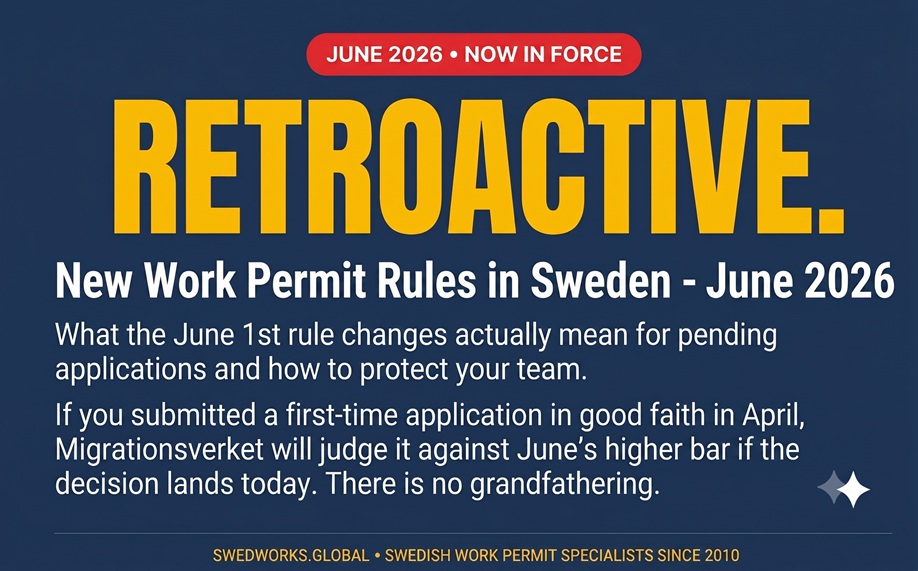
- The new salary requirement applies to all first-time applications decided by Migrationsverket after June 1, regardless of when the application was submitted.
A key takeaway from the Sweden work permit rules 2026 is staying ahead of these SCB adjustments so your applications don’t face unexpected rejections.
2. The transition rule for extensions (80% requirement)
Are you extending an existing permit? There is a transition window until December 1, 2026. If you apply for an extension between June 1 and December 1, 2026, the applicant is covered by the older 80 percent requirement instead of the new 90 percent.
Our warning:
Many believe that 80% still means exactly SEK 29,680, but the law always relies on the median salary applicable at the time of the application. If you submit an extension today, 80% is calculated on the new median salary (SEK 38,300). This means you must reach at least SEK 30,640 per month for the transition rule to work for you.
3. Exceptions in the Sweden work permit rules 2026
To help Sweden meet skills shortages, the parliament has decided that certain specific professions can be exempted from the 90 percent requirement. If the profession is on the exemption list, it is sufficient for the applicant’s salary to amount to at least 75 percent of the median salary, which at current levels equals SEK 28,725 per month.
Note that the list in effect on the day Migrationsverket makes its decision is the one that applies.
At the same time, stops are being introduced for certain professions. It is no longer possible to get a standard work permit to work as:
- A personal assistant (SSYK 5343)
- A wild berry picker (SSYK 9210)
However, if you want to hire staff to pick cultivated berries (within the same SSYK code), this is still possible and is assessed based on the standard rules.
4. Mandatory comprehensive health insurance (up to 1 year)
Another critical update in the Sweden work permit rules 2026 involves shorter stays. If the employment and stay in Sweden are expected to be a maximum of one year, the applicant must now show that they have, or have applied for, a comprehensive health insurance policy valid in Sweden.
It must cover, among other things, emergency medical care, dental care, and possible repatriation for medical reasons. This health insurance is an addition to the four standard occupational insurances that you as an employer must always provide (health, life, occupational injury, and occupational pension insurance).
5. Expanded scrutiny of the employer
Previously, the main focus was primarily on the applicant’s employment terms. From June 1, 2026, Migrationsverket has expanded possibilities to reject applications if there are shortcomings directly linked to the employer.
This means that irregularities, previous crimes, or sanctions in the company’s history can result in your dream candidate being denied a permit.
Milestone: It is therefore crucial that your company’s compliance is in absolute top condition.
Your action plan moving forward – The solutions
Under the Sweden work permit rules 2026, the country is moving rapidly toward a stricter and more salary-focused framework for labor migration. But with the right preparation, the process is fully manageable.
Here are our three quick pieces of advice for you as an employer:
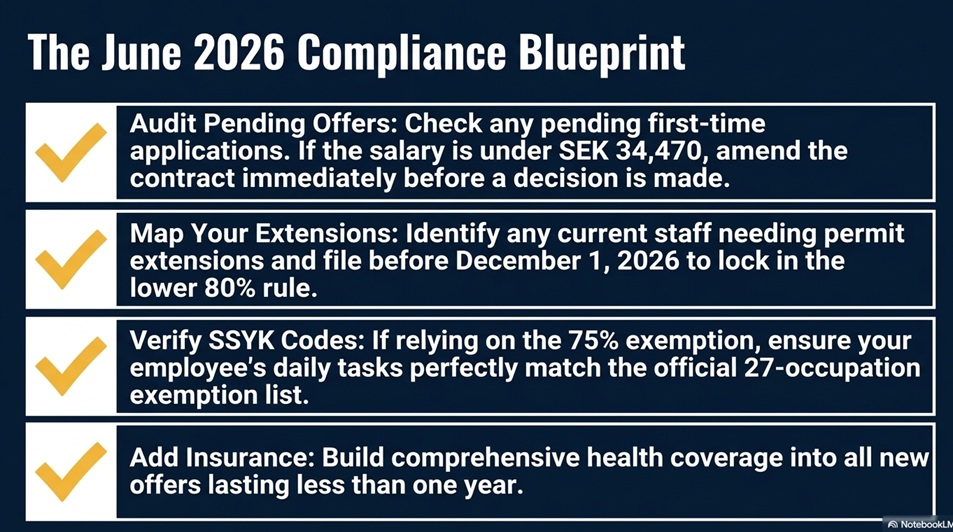
- Conduct an immediate salary audit: Review all your ongoing first-time applications. Is the offered salary below SEK 34,470? Then we should look into the possibilities of adjusting the salary up in the employment contract and supplementing the case with Migrationsverket immediately, before a rejection is issued.
- Time your extensions: Do you have staff whose permits expire soon? Ensure that the application for an extension is submitted well before December 1, 2026, to be able to use the 80 percent rule.
- Quality assure the insurances: For short employments (under 1 year), double-check that the candidate has a valid and comprehensive health insurance policy ready.
Do you want help reviewing a specific case or knowing exactly how these new rules affect your particular industry? Do not hesitate to contact us for a free assessment – we are here to help you get it right from the start.